
In this episode of Real Money, I sit down with Kris Lowe for a candid conversation on how her faith and finances intersect as she navigates business, family, and the realities many women are facing today.
Kris steps into new ground, sharing what it looks like to lead and carry responsibility while wrestling with trust, purpose, and surrender, and how those internal dynamics shape decisions far beyond money.
This conversation goes deeper than surface-level advice. It gets underneath the pressure high-achieving women carry and how that pressure shows up in their decisions, relationships, and sense of self.
Alongside a licensed therapist who serves high-achieving Christian women, she explores burnout, overfunctioning, perfectionism, and the tension between strength and surrender through both lived experience and practical insight.
Key Takeaways
- Lasting change begins by addressing emotional patterns that shape financial and personal decisions.
- High-achieving women often carry invisible burdens that require healthier boundaries and support.
- Trust, self-compassion, and aligned action create a stronger foundation for sustainable success.
Financial Perspective and Personal Change
Emotional Drivers Behind Financial Choices
Listening to Kris, what becomes clear is this: money decisions are not just practical, they’re deeply emotional.
The pressure she describes shows up in patterns I see every day with high-achieving women:
- Overcompensating through work or income
- Taking responsibility for outcomes that aren’t theirs
- Equating rest with weakness
- Feeling exhaustion but labeling it as failure
Kris speaks openly about how perfectionism and overfunctioning drive burnout.
The pattern is constant striving, planning, anticipating, and managing beyond what’s sustainable.
The shift is internal. She returns to trust as a daily discipline.
This isn’t a discipline issue. It’s overload.
That same pressure shows up in how women relate to purpose.
She speaks openly about wrestling with calling. Rather than claiming certainty, she stays in the question of whether her life reflects what she believes God has called her to.
In that process, she sees a consistent pattern. High-achieving women take on emotional, relational, and professional weight that exceeds what is sustainable.
Calling, in her view, is not constant performance. It’s alignment, shaped through reflection, trust, and daily decisions.
Aligning Money With Personal Convictions
She connects financial growth to spiritual alignment. As a follower of Jesus, she believes she is called to lead with love, forgiveness, and integrity. That conviction shapes how she runs her business, serves women, and makes financial decisions. She does not separate faith from leadership or money.
Rather than claiming certainty, she stays in the question of whether she is living what she believes she is called to.
Her approach is grounded in love, not fear or performance. She rejects using faith as a weapon and centers her walk on love, forgiveness, and trust. She leans on Proverbs 3:4, choosing to trust God rather than rely only on her own understanding.
- She reminds herself that visible circumstances are temporary
- She focuses on what is unseen rather than reacting to constant noise
- She views God as steady, not reactive to external conditions
Values-based financial transformation includes:
- Leading from love rather than fear
- Trusting stability beyond visible circumstances
- Practicing self-compassion alongside ambition
- Recognizing limits and setting boundaries
External conditions shift constantly. Grounded values provide steadiness when circumstances feel uncertain.
Financial transformation begins with internal alignment and extends outward into behavior, boundaries, and leadership.
Challenges Faced by High-Achieving Women
Striving Too Hard and Carrying Too Much
Kris describes how high-achieving women respond to pressure by doing more, fixing more, and taking on more responsibility.
It mirrors a physical strain. When one area feels unstable, they shift the weight elsewhere, even when that space can’t sustain it.
Externally, they appear capable. Internally, they are stretched thin.
The Role of Support and Boundaries
Burnout doesn’t come from effort alone. It comes from effort without support, boundaries, or recovery.
Without limits, women absorb more than they can sustain. Without support, stress becomes normalized.
What protects against that:
- Support that reduces isolation
- Boundaries that limit overload
- Rest that allows recovery
Without these, even the most capable women burn out.
Overfunctioning is how this pattern plays out in real time. It shows up as taking responsibility beyond one’s role, managing outcomes, emotions, and expectations.
That constant mental load creates exhaustion. When that exhaustion is labeled as failure, the cycle tightens. The issue is not capability. It’s capacity.
Common patterns include:
- Emotional over-responsibility
- Difficulty delegating
- Self-criticism when rest is needed
- Pressure to appear fully in control
Perfectionism reinforces the cycle. When something feels off, the response is to do more, carry more, and prove more, even when it’s unsustainable.
Without support, boundaries, and recovery, burnout is inevitable, no matter how capable someone is.
Reframing Power and Achievement
Foundational Perspectives on True Strength
Kris defines strength through love, trust, and alignment with Christ, not performance.
In her view, strength looks like:
- Loving others and herself
- Trusting God beyond what she can see
- Continuing forward without full clarity
She sees faith not as perfection, but as ongoing formation.
Ego-Driven Achievement Versus Spirit-Led Purpose
Kris speaks to the tension between external success and deeper trust.
In a world that feels unstable and reactive, she chooses to anchor in love and trust rather than control or performance.
Trust is not automatic. It is something she returns to daily.
This reframes success.
Success is not constant output. Success is not flawless performance. Success is not carrying everything alone.
Success is trusting in uncertainty, releasing what is not hers to carry, and leading from love.
Intentional Trust Compared to Emotional Withdrawal
Kris distinguishes between surrender and avoidance.
Surrender acknowledges what is real and chooses trust anyway. Avoidance suppresses emotion, overworks, or stays busy to escape discomfort.
Faith does not remove emotional strain. It changes how it is carried.
She also names a core issue. Many women are carrying more than they were meant to.
This shows up as:
- Taking on emotional weight for others
- Constant planning and anticipation
- Pressure to hold everything together
- Invisible labor at home and at work
Over time, that load builds. Fatigue is not weakness. It is overload.
To interrupt the pattern, she keeps it simple:
- Pause. Notice the fatigue instead of pushing through
- Reflect. Identify where you are overcompensating
- Seek support. Stop carrying it alone
Functioning on the outside does not mean you are well on the inside.
Trust does not remove responsibility. It clarifies what is actually yours to carry.
Closing Reflections and Practical Moves Forward
Kris is clear this work is ongoing. She continues to speak openly about faith in business, leadership, and motherhood, not from certainty, but from commitment.
She centers her next steps on love, trust, and obedience, especially when things feel unstable. She reinforces what she sees in high-achieving women. They are carrying more than they were meant to.
Her message is simple:
- Pay attention to what you’re carrying
- Stay aware of your emotional state, not just your output
- Release what isn’t yours to hold
- Get support instead of pushing through
Fatigue is not failure. It’s a signal that something needs to shift.
The work is not about doing more. It’s about carrying less and doing it differently.
ABOUT LISA CHASTAIN:
Lisa uses many tools that she used throughout her money journey and invites you to try them as well. As a first step, she recommends reading her book, Girl, Get Your $hit Together in which she helps women tackle their financial story and shares her entire story. After reading the book, she invites listeners to join the Stop Budgeting System– the very method she used to gain financial freedom and clarity.

ABOUT MY NEW BOOK:
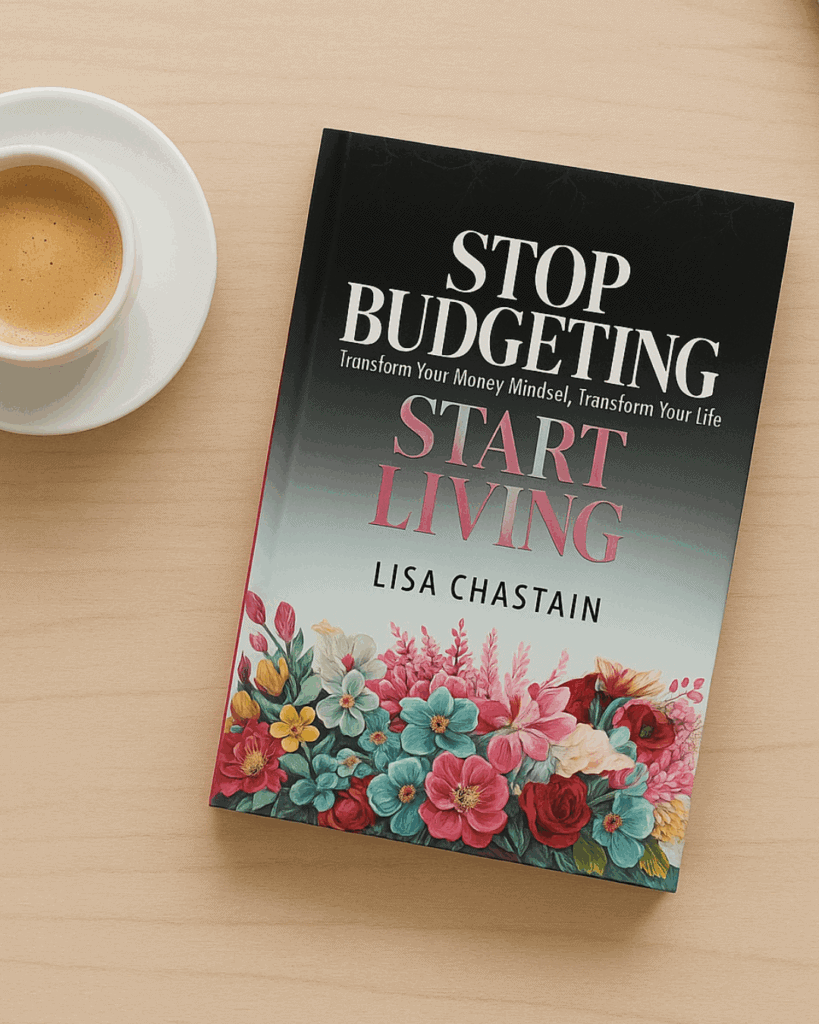
I’m beyond excited to share that Stop Budgeting Start Living is officially here! This book is the culmination of years of working with women who are ready to rewrite their money stories and step into financial confidence.
Inside, you’ll find strategies to uncover the roots of your money mindset, break free from limiting financial patterns, and create a new path toward wealth and independence.
This release feels especially powerful as we honor the progress women have made financially—and the bold steps we’re still taking together. I can’t wait for you to dive in, apply these tools, and start building the financial future you deserve.
Your journey to living fully, without the weight of restrictive budgeting, starts now.